


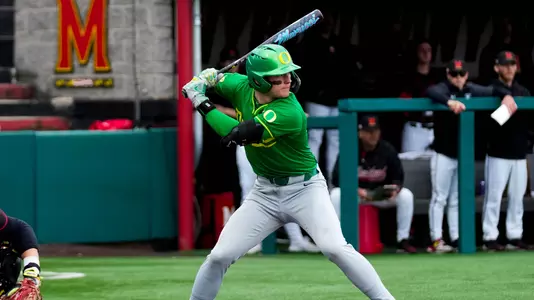
Oregon Ducks
Mark Wasikowski’s fourth consecutive 40-win team arrives at the postseason with a program-record home run pace, five straight NCAA Tournament appearances, and a roster built around three legitimate pro prospects who have carried Eugene back to relevance as one of the Pacific Northwest’s premier programs.

Los Angeles – UCLA | Atlanta – Georgia Tech | Athens – Georgia | Auburn – Auburn | Chapel Hill – North Carolina | Austin – Texas | Tuscaloosa – Alabama | Gainesville – Florida | Hattiesburg – Southern Miss | College Station – Texas A&M | Tallahassee – Florida State | Lawrence – Kansas | Eugene – Oregon | Morgantown – West Virginia | Lincoln – Nebraska | Starkville – Mississippi State
Oregon enters the 2026 NCAA Tournament as one of the most consistently excellent programs in the Big Ten — and one of the most entertaining offenses in college baseball. Mark Wasikowski, the 2025 Big Ten Coach of the Year, has now guided the Ducks to four consecutive 40-win seasons, five straight NCAA Tournament appearances, and three straight regional hosting opportunities. In 2026, the program’s home run pace is on track to challenge its single-season record of 115 set in 2025, entering the postseason at 88 longballs through 50 games ranked top-10 nationally. PK Park in Eugene is one of the most difficult environments in the Big Ten when the Ducks are healthy and at full strength.
The season’s closing stretch showed the kind of resilience that makes this team interesting entering the postseason. Oregon dropped the first game of its final series against USC in 14 innings — before Naulivou Lauaki Jr. tied the game with a home run in the ninth — and then took Games 2 and 3 to clinch the No. 3 seed in the Big Ten Tournament. The series win over USC included an extra-inning thriller that went to the 14th before Oregon walked it off. Earlier in the year, the Ducks took two of three from then-No. 1 UCLA in a top-five showdown at Haymarket Park, the highlight win on this program’s resume.
A Power-First Lineup Built Around Three Legitimate Draft Prospects
Oregon’s offense is defined by home run production and a three-headed middle-of-the-order threat that features legitimate MLB draft prospects at each slot. Senior utility/outfielder Drew Smith leads the team with 14 home runs and 47 RBI through 44 starts — earning Golden Spikes Award midseason watch list recognition — while also reaching base in 146 of his 161 career starts. His versatility, having started at four different positions plus DH, makes him the offensive anchor and the postseason’s most experienced bat in the lineup.
Junior second baseman Ryan Cooney is the most productive offensive player by rate: a .343/.426/.552 slash line with 69 hits (eighth in the Big Ten), 16 doubles (fourth in the conference), and a .978 OPS — all while batting leadoff in 35 games and third in 14 others. His five-for-five game and subsequent two-home-run Sunday at Illinois produced a 2.058 OPS weekend and earned him his third career Big Ten Player of the Week, the first Duck position player to accomplish that three times. Freshman outfielder Angel Laya broke the program freshman home run record with 13 longballs, while junior shortstop Maddox Molony — a top-125 MLB Draft prospect — has been a force in the middle of the order, homering in all three games of the Illinois series with a combined 1.794 OPS that weekend.
Golden Spikes Award midseason watch list · 146 of 161 career starts with OBP · 2025 and 2024 all-regional tournament team · starts at 4 positions + DH · top-11 Big Ten in AVG, SLG, OPS, RBI, HR
3-time Big Ten POTW — first Duck position player ever · 2.058 OPS at Illinois (5-for-5 Fri, 2-HR Sun) · 16 doubles (4th B1G) · Top-134 MLB Draft prospect · .426 OBP
Broke Oregon’s freshman home run record (prev. 11, held by Molony) · Named best freshman in the Big Ten by BTN’s Michella Chester · game-tying HR vs. USC in the 9th
Top-122 MLB Draft prospect · 1.794 OPS in Illinois series (HR in all 3 games, 8 RBI) · previous holder of Oregon’s freshman HR record · plus defensive SS
A Sophomore Ace with Elite Efficiency and a Deep, Versatile Bullpen
Sophomore right-hander Will Sanford is Oregon’s unquestioned ace and one of the most efficient starters in the Big Ten. At his best — a 1.24 ERA through his first seven starts, limiting opponents to just 16 hits including one home run — Sanford is a legitimate top-of-the-rotation arm at the next level. His ability to generate weak contact with elite command of multiple pitches gives Oregon a genuine postseason quality Friday starter who has faced and performed against the best lineups in college baseball. He posted a quality start and held Nebraska to three hits in the series the Huskers won two-of-three in Eugene.
Redshirt sophomore Cal Scolari (San Diego transfer) gives Oregon a second dependable weekend arm, posting a 2.57 ERA through his first seven starts with 43 strikeouts across 28 innings. The Ducks also deployed nine different pitchers against Gonzaga in a 4-3 victory — evidence of bullpen depth that, while unorthodox, also shows Wasikowski’s comfort using any arm in any role. Collin Clarke is the primary third starter, giving Oregon a legitimate three-deep rotation heading into regional play. The bullpen benefits from having versatile position player Drew Smith available as a two-way option in certain matchups.
| Pitcher | W-L | ERA | K | IP | Role |
|---|---|---|---|---|---|
Will Sanford RHP · So. · Friday Starter | — | ~2.80 | 80+ | 70+ | SP |
Cal Scolari RHP · R-So. · Saturday Starter (Transfer — San Diego) | 4-0 | 2.57 | 43 | 28.0+ | SP |
Collin Clarke RHP · Jr. · Sunday Starter | — | — | — | — | SP |
Devin Bell RHP · Jr. · Closer | — | — | — | — | CL |
Matthew Gosztola RHP · Jr. · High-Leverage Relief | — | — | — | — | RP |
“Will Sanford is the ace for this ball club. Through seven starts, he owns a perfect 4-0 record with a 1.24 ERA — the third lowest in the Big Ten — with 38 strikeouts in 36.1 innings, giving up only 16 hits with just one home run.”
— Oregon Ducks on SI / GoDucks.com, March–May 2026- 40-16 overall — Wasikowski’s fourth consecutive 40-win season at Oregon
- 88 team HR through 50 games (1.76/game) — on pace to challenge program record of 115 set in 2025
- 5 consecutive NCAA Tournament appearances under Wasikowski — 6th all-time at Oregon
- Ended Gonzaga’s nation-long 14-game winning streak, 4-3, at PK Park (April 28)
- Took 2-of-3 from then-No. 1 UCLA — one of two teams to win a series vs. the Bruins all season
- 14-inning walk-off win over No. 13 USC in regular-season finale to clinch B1G 3-seed
- Laya: broke Oregon’s freshman HR record (prev. 11, set by Molony in 2024)
- Cooney: 3-time B1G Player of the Week — first Duck position player to achieve the honor 3x
- Molony: HR in all 3 games of the Illinois series — 1.794 OPS over the weekend, 8 RBI
- Smith: on-base in 146 of 161 career starts · all-tournament team in last 2 postseasons
Oregon is one of the most offensively dangerous teams in the 2026 field and a program whose consistency under Mark Wasikowski deserves more national respect than it typically receives. Ninety-plus home runs at a top-10 national pace, four consecutive 40-win seasons, five straight NCAA Tournaments, wins over then-No. 1 UCLA and then-No. 13 USC, and a roster with three legitimate MLB Draft prospects in the 2026 class — this is not a program that sneaks into the postseason. PK Park is a difficult place to win for visiting teams, and Oregon is 25-plus wins at home in each of Wasikowski’s seasons.
The honest question about Oregon’s ceiling is pitching depth. Sanford at his best is as good as any Friday arm in the Big Ten, but the drop from Sanford to Scolari to Clarke represents a meaningful talent gap — particularly if the regional bracket forces Oregon into a Sunday rubber game against a program with an elite ace. The bullpen, while versatile enough to piece together nine-pitcher victories against good opponents, does not feature a shutdown closer in the mold of the best arms at other programs in the field.
The Rest of the Regional Field

Yale earned the Ivy League automatic bid with their second consecutive conference championship and draws the most difficult possible 4-vs-1 assignment: opening at PK Park against Oregon and the home run machine that has hit 88 longballs on the season. Head coach John Stuper has built the Ivy’s most consistently elite program, and Yale has genuine postseason DNA — a program that reached the Super Regional in 2024 after an upset of Notre Dame. Jack Ohman gets the ball in Game 1 against Cal Scolari, and the Bulldogs’ pitching-first approach gives them a competitive floor even in Eugene’s power-friendly environment.

Washington State wins the Mountain West automatic bid at 34-21 and draws the Eugene Regional — a bracket where they open against Oregon State in what sets up as one of the most compelling Pacific Northwest rivalry matchups in any regional. The Cougars carry the DNA of a program that competed at the Pac-12 level for decades, and their roster has power-conference-caliber talent that won’t be overmatched by the Eugene atmosphere. Nick Lewis opens against Oregon State’s Ethan Kleinschmit in Game 2, and a WSU win sends them to the winner’s bracket to eventually face Oregon’s power lineup.
Oregon State finishes 35-19 as an Independent and draws the Eugene Regional — dropping into the Ducks’ home bracket for a rivalry game with real postseason stakes. The Beavers have been one of the most inconsistent good teams in the country all season, with wins over Auburn, Arizona State, and multiple top-25 opponents mixed with surprising series losses. Their roster has legitimate pro talent and the Pac-12 pipeline that has produced multiple MLB Draft picks annually under Mitch Canham. Playing Oregon in Eugene is their natural rivalry matchup — familiarity cuts both ways. Ethan Kleinschmit opens against Washington State on Friday.
Game 1 Matchup Projections
Game 1 — Yale vs. Oregon
| RPI | Team | Projected Starter | Line / Total |
|---|---|---|---|
| 144 | Yale | Jack Ohman | 9.87 |
| 15 | Oregon ★ | Cal Scolari | -204.25 |
Game 2 — Washington State vs. Oregon State
| RPI | Team | Projected Starter | Line / Total |
|---|---|---|---|
| 82 | Washington St. | Nick Lewis | 8.87 |
| 18 | Oregon St. ★ | Ethan Kleinschmit | -192.82 |
Stadium Wind Conditions
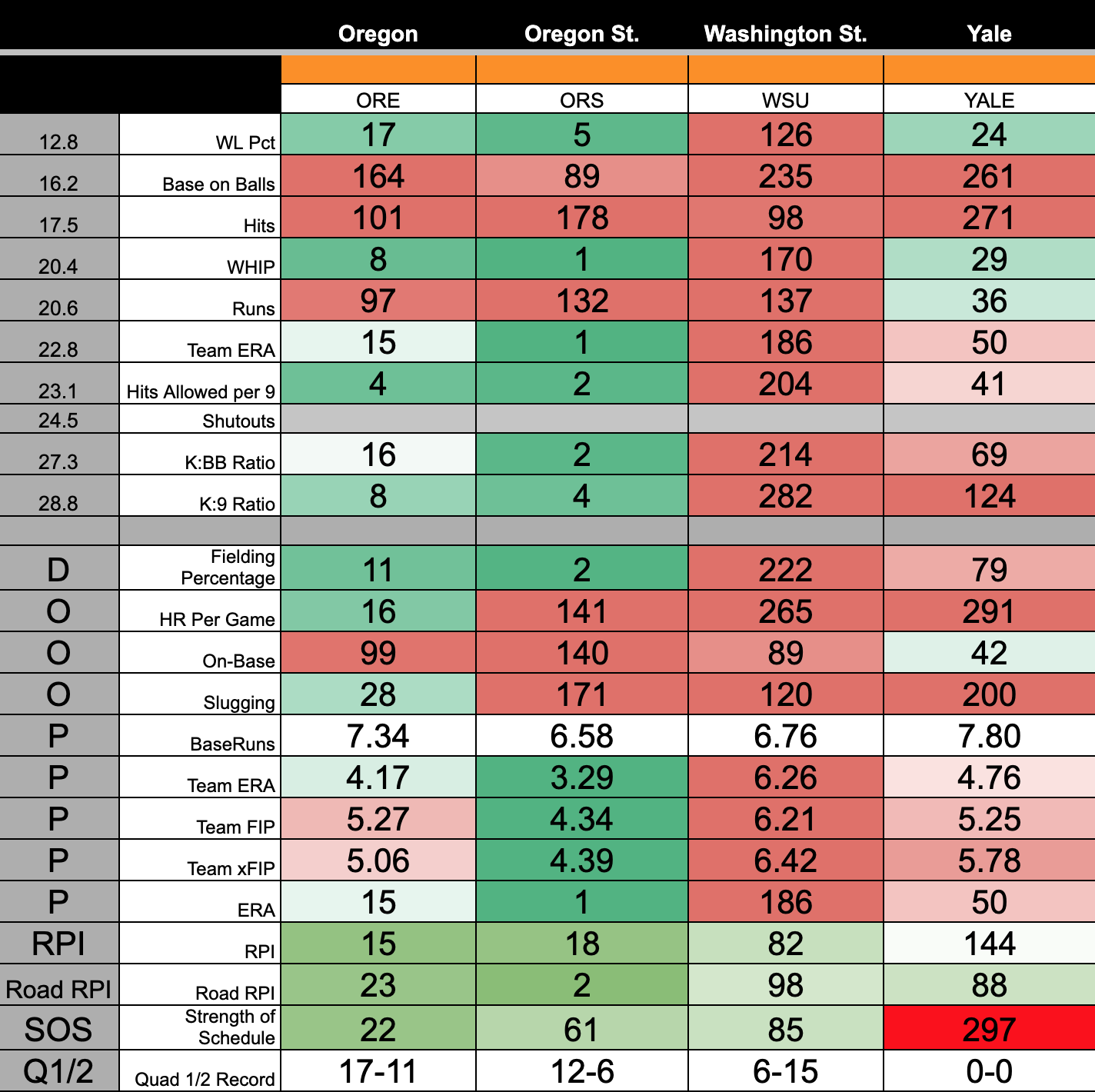
PK Park Wind Map → Windy.comRegional Pick: There is a heavy price difference between Cal Scolari and Will Sanford taking the mound against Yale. No matter which Oregon pitcher takes the mound against the Ivy League, the current number is a little inflated. Betting a 4-seed in the opening game, especially in a late time slot for an East coast team, can be a gamble. The difference is Yale is a top 40 team in runs scored and Team WHIP. The Bulldogs are a complete unknown at this stage without playing a single Quad 1 or Quad 2 game, but the analytics and inflation of Oregon could call for a run line in the opener.
Oregon State is expected to thrash Washington State after splitting a two-game set in early April that saw the Beavers post a +17 run differential. The Beavers are headed for a crash course against the Ducks after splitting two games this season. Oregon State won in Eugene on March 3rd, while Oregon took the second game in Corvallis during late April.
The numbers are similar between the two programs with a few minor differences. Oregon has the more pop at the plate as a top 30 team in slugging. Oregon State has the best pitching numbers of any Regional team, supporting a 3.3 ERA against a 4.4 xFIP. The issue with Oregon State could be a Strength of Schedule rank at 61st.
A projection of the top three starters from the Beavers and Ducks head to head would fetch Regional odds of -130 in favor of Oregon. The current market price is -125, leaving little to no value on either team from the home state of the Regional. Members of ProjectThreeStraight are holding a 50/1 future on Oregon, indication that a wager on Oregon State is needed as a hedge. For investors with that Ducks ticket in pocket, Oregon State becomes a play to make it to Omaha. The winner of this Regional will be an underdog in Austin against Texas if the Longhorns advance, but the bullpen situation will give the Beavers or Ducks a supreme pitching advantage.
- To Make Omaha: Oregon State +600
- Game 1: Yale +4.5 or Better
