


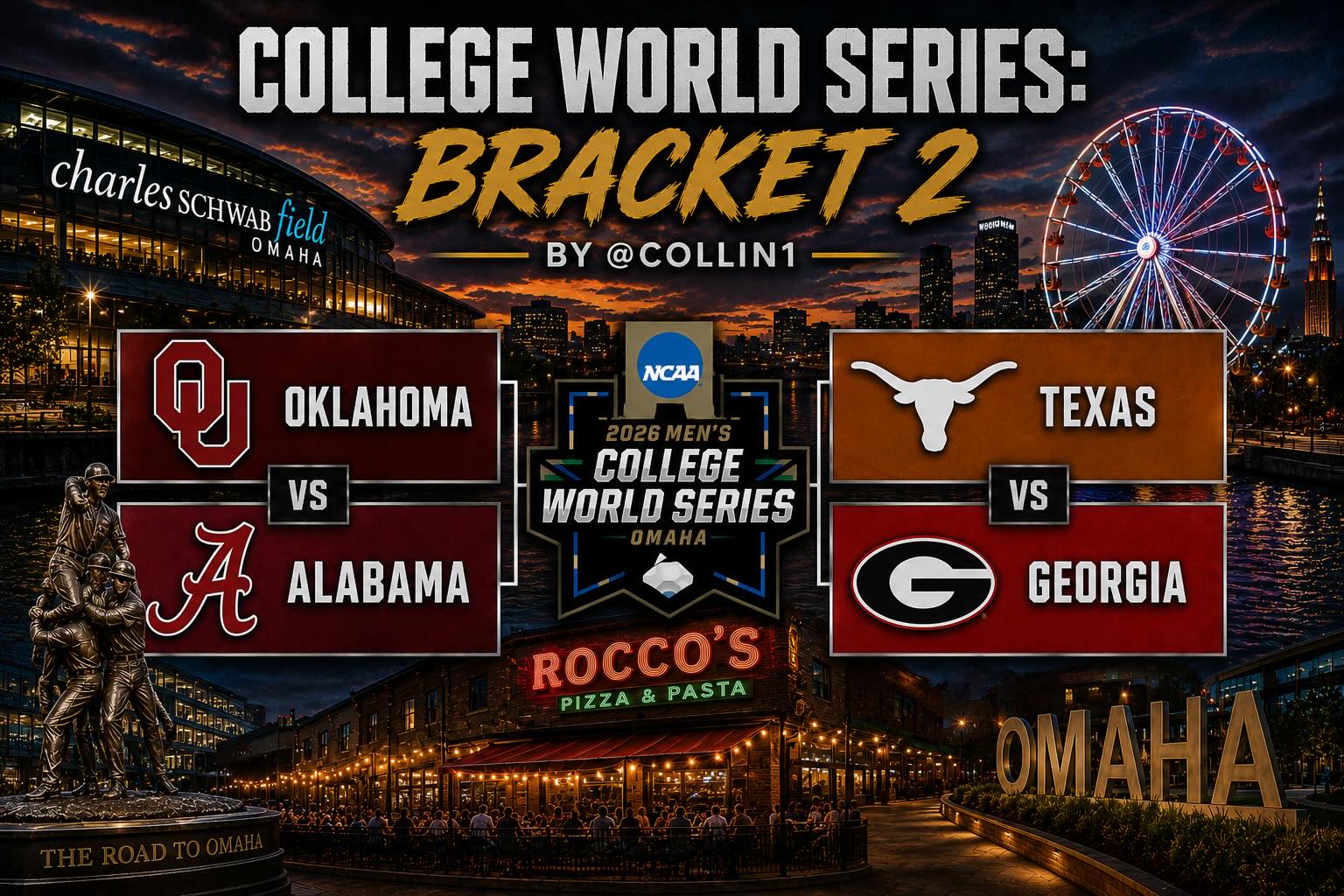




Oklahoma advanced to Omaha by outlasting Kansas, and the Sooners arrive as the lowest-seeded team in Bracket 2 at RPI #24. Cord Rager draws the opening game assignment against an Alabama staff built to suppress run scoring. The Sooners have been a team carrying real pitching concerns: Oklahoma’s team ERA of 5.19 and FIP of 6.16 are the highest of any team in Bracket 2, and the xFIP of 5.38 confirms the surface numbers are not masking hidden quality. Cam Johnson was once the Friday night anchor, but has seen multiple early exits in recent contests. LJ Mercurius once held the role of Friday night starter, only to be pushed into long relief with a recent strong appearance in the Super Regionals against Kansas. Despite the carousel of starting pitchers, this staff ranks as a top 20 team in hits allowed per nine innings.
The saving grace is a strength of schedule of #7 nationally, the toughest road traveled of any team in this bracket, which means the Sooners have already faced elite arms and survived. The trouble is everything around the rotation: a fielding percentage outside the top 100 and an offense that ranks #102 in on-base and #108 in runs leave almost no margin for error in a park this size. For Oklahoma to win games in Omaha, Rager and the staff have to keep the ball on the ground and let a schedule-tested lineup scratch out just enough.
Alabama reached Omaha on the strength of its pitching, dispatching St. John’s in Tuscaloosa behind a staff that ranks among the best in Bracket 2 at limiting runs. Tyler Fay gets the opening start with a real edge in the box score: Alabama’s team ERA of 4.21 (rank #16) and WHIP (#21) trail only Texas in this bracket, and the Crimson Tide own the #2 strength of schedule in the entire field.
The concern that follows Alabama to Omaha is everything that happens once the ball is in play. Alabama’s fielding percentage of #247 is the worst of any team in the College World Series field, and the offense ranks in the bottom third nationally in hits (#177), on-base (#173), and slugging (#130). In Charles Schwab Field, where defense is magnified across the largest outfield in college baseball, that glove is a structural liability. Fay can keep Alabama in any game; the question is whether the bats and the defense hold up behind him.
Texas advanced past Oregon in Austin in what projected as the highest-quality Super Regional in the country. The Longhorns arrive in Omaha as the most complete team in Bracket 2. Dylan Volantis, the premier arm in this half of the bracket, headlines a staff that grades out elite across the board: Texas ranks #6 in WHIP, #3 in K:BB ratio, and #4 in walks allowed, with a team xFIP of 4.41 that is the best sustainable pitching number of any team in Bracket 2.
The Longhorns pair that staff with a top-25 defense (#21) and a balanced offense that sits inside the top 20 in on-base (#18), slugging (#14), and home runs per game (#17). The one blemish on the resume is a Road RPI of #49, the weakest neutral-site number among the contenders, but Omaha is exactly the pitching-and-defense environment that rewards what Texas does best. Volantis on the mound with a clean glove behind him is the formula that wins in this park.
Georgia is the offensive engine of Bracket 2 and arrives in Omaha after taking down Mississippi State in Athens. Joey Volchko draws the opening game start, but the story from Foley Field has always been the lineup: Georgia ranks #1 nationally in home runs per game, #2 in slugging, #4 in on-base, and posts a BaseRuns of 10.26 that leads every team in this bracket.
This is not a one-dimensional power club either. The Bulldogs rank #3 in hits and #4 in runs, with a top-10 defense (#10) and a Road RPI of #5 that confirms they win in neutral environments. The question that decides Georgia’s ceiling is pitching: a team ERA of 4.87, a FIP of 5.63, and an xFIP of 5.10 all suggest a staff that can be exposed by disciplined lineups. If Volchko and the arms hold up, the Georgia offense is good enough to win this bracket outright.
National rank shown per category; lower is better. Green = top 25 nationally; Red = bottom half nationally.
Oklahoma vs. Alabama
| Team | Projected Starter | Line / Total |
|---|---|---|
Oklahoma Cord Rager |
Cord Rager | 11.04 |
Alabama ★ Tyler Fay |
Tyler Fay | -112.28 |
This is the closest game on the Bracket 2 board, and the line reflects it: Alabama opened -120 as a small favorite over Oklahoma. These teams met before in early April SEC play, a Crimson Tide 2-1 series victory in Norman. LJ Mercurius allowed 7 earned runs for the Sooners in the first two innings of the series. Cam Johnson struck out 8 in 6.1 innings to avenge Oklahoma in Game 2 over Zane Adams and the Crimson Tide. The rubber match ended 3-2 in favor of Alabama thanks to the pitching of Myles Upchurch and Matthew Heiberger. Oklahoma had a costly error that resulting in two runs, the difference in the game and the series loss to Alabama.
The separation, such as it is, comes on the mound. Tyler Fay anchors a staff that ranks #16 in team ERA and #21 in WHIP, while Oklahoma brings the weakest pitching profile in the bracket, a team ERA of 5.19 and a FIP of 6.16 that is the worst of any team in Omaha. On arms alone, Alabama is the better team.
What keeps this a coin flip is everything else. Alabama’s fielding percentage of #247 is a genuine liability in a park as spacious as Charles Schwab Field, where balls in the gap become extra bases and defense is magnified. Oklahoma’s own glove (#111) and bat (On-Base #102, Runs #108) are nothing to lean on either, which is why this projects as a low-scoring, mistake-driven game. Both offenses rank in the bottom third nationally, so the team that catches the ball and gets six clean innings from its starter likely advances.
Pick: Under XX Tyler Fay and Cord Rager project at 11 runs for this contest. LJ Mercurius is sure to come in for long relief if there is trouble for the Sooners, while the Tide have turned to Matthew Heiberger for successful shutdowns all season. Friday is calm from a wind perspective at Charles Schwab, but Saturday could be an entirely different ballgame. The winds are projected to be blowing in right and centerfield.
Stadium Wind Conditions · Charles Schwab Field, Omaha NE
Charles Schwab Field Wind Map → Windy.comTexas vs. Georgia
| Team | Projected Starter | Line / Total |
|---|---|---|
Texas ★ Dylan Volantis |
Dylan Volantis | -156.31 |
Georgia Joey Volchko |
Joey Volchko | 12.21 |
This is the marquee matchup of Bracket 2 and the cleanest pitching-versus-hitting contrast in the entire field. Dylan Volantis is the best arm in this half of the bracket, and Texas backs him with a staff that grades out elite across the board: #6 in WHIP, #3 in K:BB ratio, and a bracket-best xFIP of 4.41. Georgia counters with the most dangerous lineup in Omaha, led by a national #1 ranking in home runs per game and a BaseRuns of 10.26 that tops every team here.
These two teams did not meet in SEC play, but the setting tilts the matchup toward Texas. Charles Schwab Field is the largest outfield in college baseball, and a Georgia offense that leads the nation in home runs per game loses a measure of its identity when the fences move back. Georgia is far from one-dimensional, ranking #3 in hits and #4 in on-base, so the bats will not vanish; but Volantis and a top-25 Texas defense are built to limit the damage. Joey Volchko has the tougher assignment, facing a Texas lineup that ranks top 20 in on-base and slugging against a staff that walks fewer hitters than almost anyone in the country. Location has been a concern for Volchko at times, throwing off speed pitches that often have enough spin to land outside the strike zone.
Pick: Texas -115 or Better. The Longhorns have the best pitcher, the deeper staff, and a ballpark that could contain the Georgia sticks while putting the top 25 Texas defense on display.
Pitching, Defense, and the Georgia Bats
Omaha is about pitching and defense, and that thesis sorts Bracket 2 quickly. Two of these four teams carry flaws that are difficult to hide across a double-elimination format in the largest park in college baseball.
Oklahoma is the longest shot. The Sooners own the worst pitching profile of any team in the field, a team ERA of 5.19 backed by a FIP of 6.16, and a fielding percentage of #111 that compounds the problem. Head coach Skip Johnson has dealt with a carousel of starting pitchers this season, but will need his best managing performance in Omaha. A strength of schedule of #7 means Oklahoma has been battle-tested, but a staff that surrenders this much contact, paired with an offense ranked #102 in on-base, is not built to win three or four games in Omaha.
Alabama is the more painful case, because the pitching is genuinely good. A team ERA of #16 and a WHIP of #21 would play anywhere. The trouble is a fielding percentage of #247, the worst in the field, paired with an offense that ranks in the bottom third nationally in hits, on-base, and slugging. In a park where defense is magnified, a glove that ranks #247 is the kind of structural flaw that ends runs in the losers bracket. If this were a three game series, Alabama would be a short favorite of -135 over the Oklahoma.
That leaves Texas and Georgia as the real bracket final, and it is the cleanest pitching-versus-offense question in the field. Georgia brings the bigger bats, a top-10 defense, and a Road RPI of #5; the Bulldogs can win this bracket if their arms hold up. But the pitching numbers, a team ERA of 4.87 and an xFIP of 5.10, are the reason for pause against disciplined lineups.
Texas profiles as the pick. The Longhorns own the best sustainable pitching in the bracket at xFIP 4.41, a top-25 defense, and the premier arm in Dylan Volantis, exactly the formula that survives Omaha. The Longhorns already have a combined 5-1 record against Alabama and Oklahoma from SEC conference play. Texas would be a -150 favorite in a fictitious series price against Georgia and a minimum -320 over Alabama and Oklahoma. Make no mistake, when Dylan Volantis is not pitching the Horns are much more vulnerable. An opening win behind the ace could keep him fresh for the Bracket 2 finale.
Bracket 2: Texas
