


Road to Omaha



West Virginia swept Cal Poly in the Morgantown Super Regional with exactly the kind of performance that defines this program: Chansen Cole dominated Game 1 as a massive favorite, Yehl followed with the same efficiency in Game 2, and the Mountaineer bullpen was never seriously tested. The Kendrick Family Ballpark crowd delivered on every promise of the program’s first-ever Super Regional, and Steve Sabins’s team arrives in Omaha fully rested with their entire rotation intact and on schedule.
The bullpen has been WVU’s quiet strength all season. Ian Korn (2.96 ERA, 48.2 IP) functions as a third starter in high-leverage multi-inning roles, and the backend combination of Carson Estridge and Reese Bassinger has been precise in protecting leads that Cole and Yehl build. WVU’s team ERA of 3.82 (rank #7 nationally) entering Omaha is the best of any team in Bracket 1, and their H/9 of #10 reflects a staff that keeps the ball out of the barrel consistently. Against a Troy offense that generated runs late in the Gainesville Regional, WVU’s ability to go deep into games with their starters limits exposure to any late-inning volatility.
Troy swept Little Rock at Riddle-Pace Field behind Benjamin Stubbs and Tommy Egan, with Hayden Smith waiting unused in the bullpen as the series never reached a third game. The Troy offense delivered consistent run support throughout the weekend, and the Trojans arrive in Omaha as the lowest-seeded team in this bracket with a schedule strength of #6 nationally; this program has been battle-tested against the best competition all season.
The honest concern for Troy in Omaha is their bullpen depth behind the top three arms. Their team ERA of 5.64 and FIP of 5.82 are the highest of any team in Bracket 1, and their H/9 of #146 and WHIP of #114 reflect a staff that will give up baserunners when it leans on depth arms. The xFIP of 5.59 confirms the ERA is not being propped up by luck; Troy simply allows more contact than WVU or North Carolina. Against WVU’s lineup, which generates contact rather than home runs (HR/game #168), the Trojans’ best path is keeping the game close enough for Stubbs to handle the first six innings before the bullpen is tested.
North Carolina did exactly what our Super Regional previews predicted: a Game 1 loss to USC’s Mason Edwards, a Jason Decaro elite performance in Game 2, while Caden Glauber closed a tight coin flip Game 3 at Boshamer. The 2-1 series was a testament to the pitching staff, with Game 1 and 3 receiving strong contributions from bullpen arms. Scott Forbes’s program arrives in Omaha at 50-12-1, one of the best records in the field, with a Road RPI of #3 that confirms they can win anywhere. With Decaro fresh off a complete game shutout, the Heels will be tough to beat with their ace on the mound.
UNC’s bullpen has been reliant on the tandem of Jackson Rose and Walker McDuffie. North Carolina’s base on balls rank of #6 nationally is the best in Bracket 1; the Tar Heels limit free passes at an elite level, which keeps rallies from compounding even when contact is allowed. Their K:BB ratio of #64 is below average but sustainable in the postseason format, and their runs-allowed rank of #23 reflects a staff that gives up hits (#20 nationally) but suppresses damage through ground-ball tendencies. Against an Ole Miss lineup that ranks #14 in walks-drawn nationally, North Carolina’s command advantage on the mound is the defining structural edge in Game 2.
Ole Miss entered Plainsman Park as an underdog against Auburn, advancing to Omaha thanks to a dominant pitching performance. Longtime staff ace Hunter Elliott avoided trouble in Game 1, allowing 2 earned runs over 4.1 innings. Sophomore Taylor Rabe was electric in Game 2, allowing just 2 earned runs over 7.1 innings. Rabe has now struck out 44 batters in his past four starts against Texas A&M, Alabama, Nebraska and Auburn. The Rebels were so good in the Super Regional round, the electric arm of third starter Cade Townsend was not even used.
Ole Miss arrives in Omaha with something to prove and elite numbers in strikeout to walk and strikoout per nine ratio. Their K:BB ratio of #6 nationally is the best in Bracket 1 by a significant margin, and their K/9 of #7 confirms a staff that misses bats at an elite rate when healthy. The xFIP of 4.50 is the best advanced pitching number of any team in Bracket 1 and reflects a staff that should perform at a higher level than their Super Regional showing. If Elliott is right and the Rebel bats find their rhythm in Omaha, this is a dangerous team. Their SOS of #3 means they’ve already beaten teams at this level.
National rank shown per category; lower is better. Green = top 25 nationally; Red = bottom half nationally.
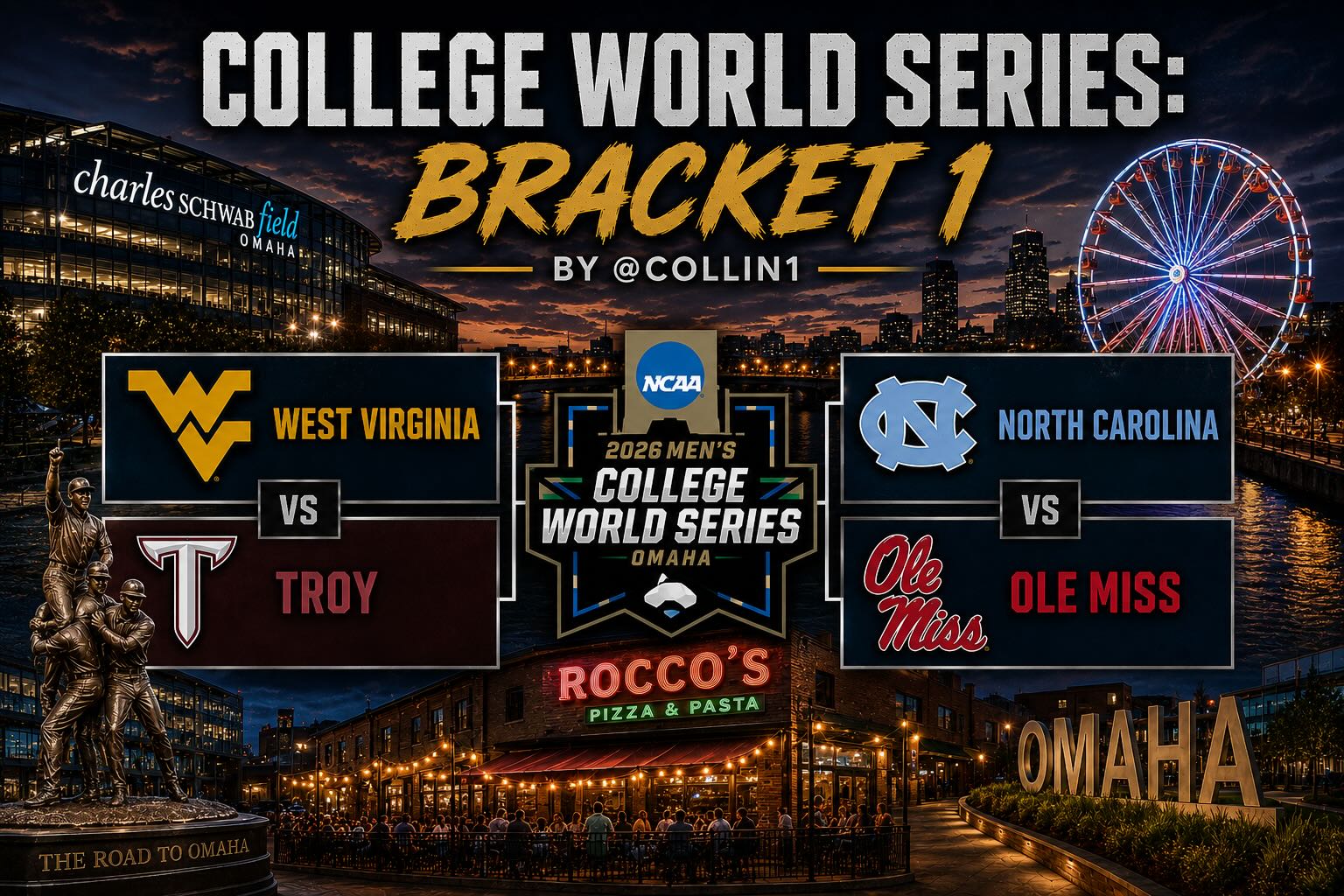
Troy vs. West Virginia
| Team | Projected Starter | Line / Total |
|---|---|---|
Troy Benjamin Stubbs |
Benjamin Stubbs | 11.03 |
West Virginia ★ Chansen Cole |
Chansen Cole | -225.93 |
Troy’s calling card has been a hot offense and avoidance of calls to the pen. Over the past 6 games the Trojans have averaged more than 11 runs per game. The coming out party was against Florida in Regionals, tagging Liam Peterson for 9 earned runs. Skylar Meade’s sticks have been hot, overachieving in all hitting departments from season averages. However, there are two elements that favor West Virginia in Omaha.
Charles Schwab Field is enormous, where line drives in the gap are the key to hot offense over the long ball. The Mountaineers have been excellent at small ball, ranking top 30 in doubles and triples but in the bottom half of Division I in home runs per game. West Virginia forces opponent defenses to field sacrifice flies, bunts and squeezes. Fielding percentage always plays in spacious Charles Schwab, with West Virginia in the top 25 compared to a rank of 84th for Troy.
Chansen Cole will be fully rested after the Super Regional sweep of Cal Poly, Troy’s best approach is patience and contact. Cole’s H/9 of #10 nationally and ERA of 2.71 describe a pitcher who does not give away free baserunners; Troy will need to string together hits rather than working walks to generate runs. Benjamin Stubbs held his own through the Super Regional against Little Rock but this is a different assignment entirely. WVU’s BaseRuns of 7.94, driven by Gavin Kelly (.391, 12 HR) and Armani Guzman (30 SB), will generate pressure from the first pitch.
The bullpen matchup after the starters is where this game could become competitive. WVU’s FIP of 5.44 and xFIP of 5.12 both run above their ERA; Korn, Estridge, and Bassinger have been precise all season but the CWS environment is new for all of them. Troy’s own bullpen, which carries a team WHIP of #114 and H/9 of #146, could become a liability if Stubbs is pulled before the seventh and WVU’s lineup gets into the weaker arms.
Pick: West Virginia -210 or Better
Stadium Wind Conditions · Charles Schwab Field, Omaha NE
Charles Schwab Field Wind Map → Windy.comOle Miss vs. North Carolina
| Team | Projected Starter | Line / Total |
|---|---|---|
Ole Miss Hunter Elliott |
Hunter Elliott | 11.26 |
North Carolina ★ Ryan Lynch |
Ryan Lynch | -131.68 |
This is the most compelling individual game matchup of Bracket 1 opening day. Ole Miss will more than likely turn to Hunter Elliott to start the College World Series, although Cade Townsend could get the start as the freshest option on staff. North Carolina projects as a -131 favorite with Ryan Lynch starting against Elliot, but if Townsend gets the call Ole Miss projects as a slight -120 favorite. Ole Miss’s K:BB ratio of #6 and K/9 of #7 nationally are the best strikeout metrics of any team in this entire bracket; when Elliott is locating his fastball, he generates strikeouts against disciplined lineups.
The game could come down to the Tar Heels starter and his pitch arsenal, as Ryan Lynch prefers to throw a high quality fastball. Ole Miss has the ability to get balls out of the park when a fastball comes down the pipe, ranking top 20 nationally in home runs per nine innings. The biggest difference in this game might be the pitcher each team selects to close out the game. Walker Hooks will get the call for Ole Miss, boasting 61 strikeouts to just 11 walks. Walker McDuffie has had a different path for North Carolina in recent appearances. The Sophomore was tagged for two earned runs against East Carolina in Regionals and four earned against USC in the Super Regionals.
Backing Hunter Elliott can be a roller coaster of runners left on base. The usage of Cade Townsend is an important piece in this opening game, as the rising star was warming up on the closing moments of the Supers win against Auburn. If Townsend comes out of the bullpen and is followed by Hooks, Ole Miss has a pitching advantage against a North Carolina team that earns a paycheck based off elite pitching.
Pick: Ole Miss +130
Omaha is about Pitching and Defense
The wind will be slightly blowing out to left field in Friday’s opening games, but Omaha is about pitching and defense. Troy has played one of the toughest schedules in the nation while peaking from an offensive standpoint. The Trojans have had one of the tougher paths despite a Super Regional victory over Little Rock. There are two major issues with Troy winning Bracket 1: poor fielding percentage and only three stable pitchers. Tommy Egan, Benjamin Stubbs and Cooper Ellingworth have been the trustworthy arms for the Trojans, but a Regional-style format could empty the bullpen quickly. Because of the poor bullpen numbers and limitations on quality arms, Troy is not a team that is build to comeback in the losers bracket.
There are very similar profiles for Ole Miss, West Virginia and North Carolina. All three offenses draw walks, while the Rebels have the best home run pop. Both the Mountaineers and Tar Heels are heavy in on-base percentage, but Ole Miss falls short in the area of fielding percentage.
West Virginia would be a -180 favorite in fictitious series price against Ole Miss and -140 over North Carolina. The Mountaineers have plenty of favorable metrics that fit the profile of teams that have previously won the national title. West Virginia is 10th in hits allowed while supporting the lowest staff ERA of any time in ERA. Chansen Cole, Maxx Yehl and Ian Korn are backed by a top 25 defense and an offense that excels in moving base runners station to station.
Bracket 1: West Virginia
